




Description
The Otranto Walking Tour is the perfect choice for those who want to discover the wonders of the ancient city accompanied by a certified expert guide.
The tour begins at the Aragonese Castle, the imposing manor that inspired Horace Walpole's first Gothic novel. The castle's current appearance is the result of a complete reconstruction carried out after the city's reconquest in 1481. The original quadrangular structure, centered on four cylindrical sloping towers and separated from the rest of the urban fabric by a deep moat, was altered in the second half of the 16th century with the addition of a mighty bastion that extends all the way to the port. Access via a masonry bridge, originally a wooden drawbridge, features the coat of arms of Charles V of Habsburg on its façade, the ruler under whom the castle was strengthened, making it one of the cornerstones of the Kingdom of Naples's defensive system against the Turks.
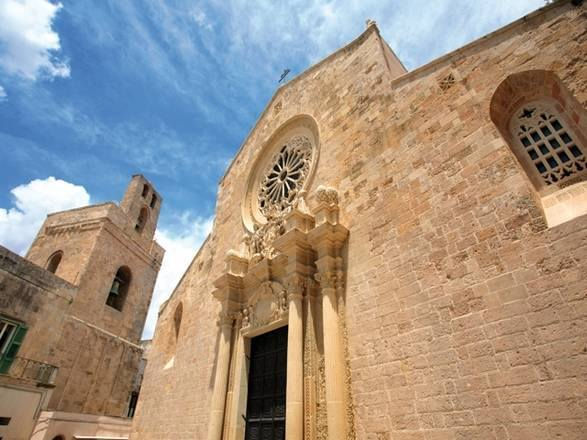
Through narrow streets and picturesque views, Via Cenobio Basiliano leads to the Cathedral, which dominates the triangular Piazza Basilica, the religious heart of Otranto and a treasure trove of Otranto's history. Consecrated in 1088, the spacious building has three naves divided by two rows of columns with capitals and a splendid gilded wooden coffered roof from 1693.
The most striking feature is undoubtedly the magnificent mosaic floor that covers the entire central nave and much of the side naves. The large tree, nestled among its intricate branches, houses a multitude of human figures, animals, mythological monsters, and significant elements from all cultures: biblical, Christian, mythological, Hellenistic, Breton, and Arab.
At the end of the right nave is the Chapel where the mortal remains of the martyrs of the 1480 massacre rest, placed in seven tall glass cases.
The Crypt represents the most evident connection between East and West to date, celebrating the union of Mediterranean peoples. It is built on 42 monolithic and inlaid columns (differing in material quality, style, and production time) and 23 semi-columns, forming 45 square bays, plus three in the central apse, divided into 5 rows by 9. The columns are in Ionic, Corinthian, Asian, Egyptian, Islamic, Lebanese, Byzantine, and Persian styles.
The central apse features frescoes of the Madonna Hodegetria (12th century) and Christ the Master (Italo-Greek school).
The walk ends near the Monument to the Heroes and Martyrs of Otranto, erected in memory of the resistance of Otranto and its citizens to the Turkish siege. The female allegory of the city of Otranto is depicted as a heroine proudly turning toward the sea, from which the invading Turks arrived. She is also wrapped in a flowing cloak (with the coat of arms of the city of Lecce) and wears a headdress bearing the city's coat of arms. The sculptural project dates back to 1907.
Duration: 2 hours
Contacts
ALL


Suggstions
Otranto welcome recommends
Discover Otranto in an innovative way with your smartphone?
Otranto.app is the perfect companion for exploring the city from every angle.
Otranto.app knows the city like the back of its hand. The app not only features the most famous attractions, but also markets, events, restaurants, and accommodations, all easily accessible via the map feature.
It also suggests activities & sports, relaxation and wellness options, guided visits & tours to make your vacation in Otranto and Salento unforgettable.
